Mr. Heng ·
guides  | |
| |
Why Does My Aircond Smell Musty? (Mould, Bacteria & How to Fix It)
Mr. Heng
Founder & Lead HVAC Technician
musty smellmouldaircond odour
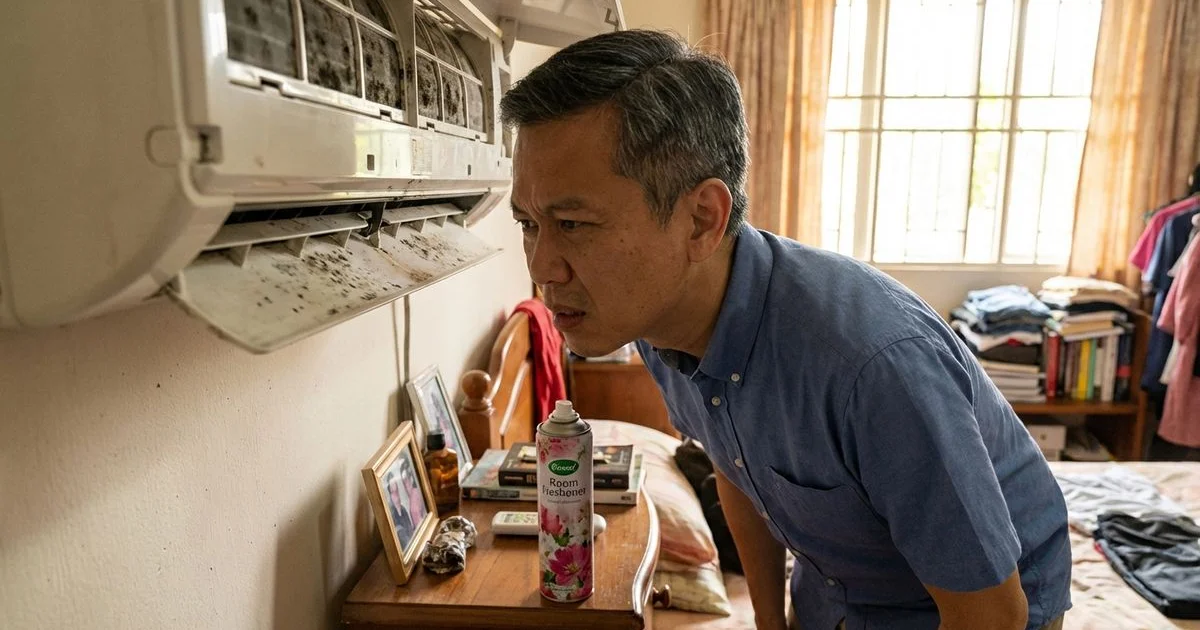
You switch on your aircond and immediately get hit with that damp, sour scent—like wet socks left in a gym bag. It makes you wrinkle your nose instantly. We hear this complaint constantly from homeowners in Petaling Jaya and Kuala Lumpur, and the culprit is almost always the same: active mould and bacteria colonies growing inside your unit.
Malaysia’s tropical climate creates a unique challenge for cooling systems. With outdoor humidity levels in the Klang Valley averaging between 78% and 82% year-round, your air conditioner isn’t just cooling air; it is fighting a constant battle against moisture. Here is exactly why that smell happens, the specific health risks for your family, and the only way to fix it permanently.
Why Does Your Aircond Smell Musty?
Your air conditioner inadvertently creates the perfect laboratory for mould growth. During operation, the evaporator coil cools air significantly below its dew point. This process causes moisture to condense rapidly on the coil fins and drainage pan, similar to water beads forming on a cold drink.
Dust and organic skin particles pass through your standard filters and stick to this wet coil. This combination creates a “bio-film”—a nutrient-rich, damp layer where mould spores thrive. In our local climate, where night-time humidity often hits saturation point, this interior dampness never truly dries out naturally.
The 5 Main Causes
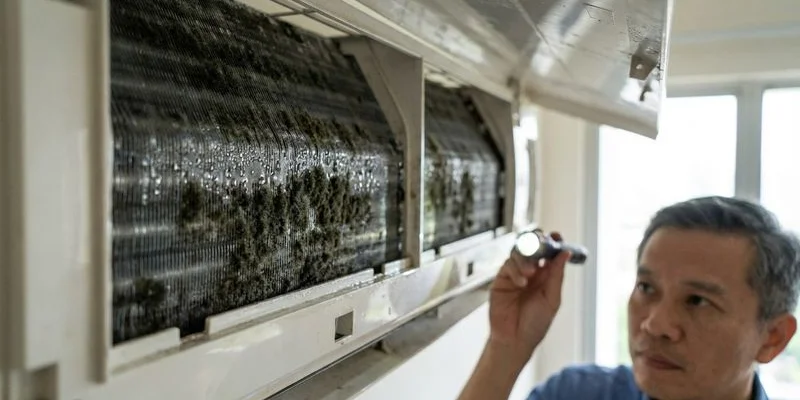
1. Mould on the Evaporator Coil (Cladosporium & Aspergillus) The cooling coil is the primary breeding ground. Research on tropical HVAC systems identifies Cladosporium and Aspergillus as the most common fungi found on these damp surfaces. As air passes over the infected coil, it picks up spores and distributes that characteristic musty odour into your room. You are effectively circulating air through a layer of mould.
2. Biofilm “Jelly” in the Drainage Pan The pan sitting below your coil collects condensation water. If the water doesn’t drain immediately, it forms a thick, gelatinous slime often called “biofilm.” This bacterial jelly releases a sour, vinegar-like smell and can eventually block your drainage pipe, leading to leaks.
3. The Dirty Blower Fan The barrel fan (blower) is often overlooked by standard cleaning. Over months of use, the curved blades accumulate a heavy layer of dust and moisture. This creates a secondary surface for mould colonization. A dirty blower fan physically flings spores and dust clumps out with the cool air.
4. Blocked or Slow Drainage When algae blocks your drainage pipe, water backs up inside the unit. This creates a permanent pool of stagnant water. The resulting humidity inside the unit hits 100%, accelerating mould growth on every internal surface.
5. Infrequent Usage Airconds in guest rooms or holiday homes are highly susceptible. When a unit runs, the condensation helps wash some dust away. When it sits idle for weeks after being used, the lingering moisture allows mould to establish deep roots without disturbance.
Health Risks of a Mouldy Aircond
The smell is your warning sign that indoor air quality has dropped to unsafe levels. When you run a mouldy aircond, you are aerosolizing spores directly into your breathing zone.
Recent data highlights the impact of this exposure. Studies on urban populations in Malaysia have shown that symptoms of allergic rhinitis are increasingly common, with some reports indicating that up to 55% of students in the central region (like KL) experience related symptoms.
Immediate Symptoms
- Sneezing and runny nose: A direct histamine response to inhaling spores.
- Itchy, watery eyes: The most common sign of an allergic reaction to airborne irritants.
- Sore throat: Often caused by the drying effect of the AC combined with bacterial irritation.
- Skin irritation: Spores can aggravate eczema and sensitive skin.
Longer-Term Effects
- Asthma triggers: Mould is a proven trigger for asthma attacks.
- Chronic sinusitis: Constant exposure leads to inflammation of the sinus linings.
- Fatigue and headaches: Poor air quality forces your body to work harder for oxygen.
- Weakened immunity: Continuous exposure places stress on the immune system, particularly in children and the elderly.
Who Is Most at Risk? Young children are particularly vulnerable because their respiratory systems are still developing. The elderly, asthma sufferers, and pregnant women also face higher risks. If the smell comes from a bedroom unit, you are breathing these contaminants for 6-8 hours every night.
Types of Smells and What They Mean
Diagnosing the specific scent can help you identify the severity of the problem.
| Smell | Likely Cause | Urgency | Action Required |
|---|---|---|---|
| Musty / Old Socks | Mould on evaporator coil | Medium-High | Chemical Wash |
| Sour / Vinegar | Bacterial slime in drain pan | Medium | Chemical Wash & Drain Flush |
| Rotten / Garbage | Dead insect (lizard/cockroach) | High | Immediate Removal |
| Sweet / Chemical | Refrigerant gas leak | Very High | Leak Check & Repair |
| Burning / Plastic | Overheating motor/wiring | URGENT | Turn Off & Call Tech |
| Stale / Dusty | Heavy dust accumulation | Low-Medium | General Service |
How to Fix the Musty Smell
Quick Fix (Temporary Relief)
These steps might reduce the odour for a few days, but they will not solve the underlying issue:
- Wash Filters: Remove and scrub filters with mild detergent.
- Surface Wipe: Clean visible dust from the louvres and casing.
- Heat Dry: Run the unit on Fan Mode at the highest speed for 45 minutes. This helps dry out the damp coil temporarily.
- Ventilate: Open all windows for 20 minutes to flush out trapped VOCs and spores.
The Permanent Solution: Alkaline Chemical Wash
The only way to physically remove established mould colonies is a professional chemical wash. Standard water cleaning is often insufficient because mould roots can penetrate the microscopic pores of the aluminium fins.
Our technicians use a specific Alkaline-based cleaner for this purpose. Here is why the chemistry matters:
- Alkaline Cleaners: Best for breaking down organic matter like mould, grease, and bio-film without corroding the metal.
- Acidic Cleaners: Generally used only for hard mineral scaling. They are too harsh for regular cleaning and can damage your coil if used incorrectly.
The PJ Kool Process:
- Full Dismantling: We remove the front panel, filters, and water tray.
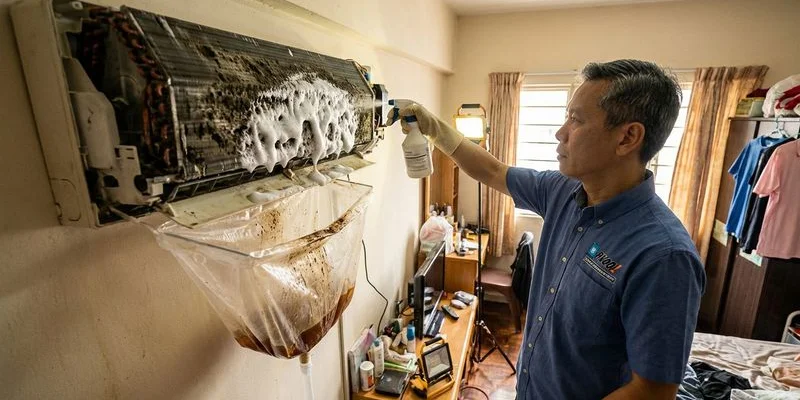
- Alkaline Application: We apply a foaming anti-bacterial solution that penetrates the coil fins to dissolve the bio-film.
- High-Pressure Rinse: A thorough flush removes the dissolved slime and dead mould spores.
- Blower & Tray Cleaning: We scrub the blower fan and drainage pan to ensure no colony is left behind.
- Drainage Flush: We clear the pipe to prevent future stagnant water.
- Gas Check: We verify your refrigerant levels (complimentary at PJ Kool).
- Final Test: We run the unit to confirm the air is fresh and odorless.
Severe Cases: Chemical Overhaul
If a unit hasn’t been serviced in years, mould may have impacted the back of the cooling coil where a standard wash cannot reach. In these instances, we recommend a chemical overhaul. This involves unmounting the entire unit from the wall and disassembling every component for a complete immersion cleaning.
Signs you need an overhaul:
- The smell returns within 4 weeks of a standard chemical wash.
- You see thick black specks on the blower fan or louvres.
- The unit is leaking water due to a “jelly” blockage.
Preventing Mould From Returning
Once your aircond is clean, you can use these strategies to keep it that way.
1. The “Fan Mode” Habit
Moisture is the enemy. After you turn off the cooling function, switch your aircond to “Fan Mode” (not Auto or Cool) for 20-30 minutes. This blows dry air over the wet coil, evaporating the condensation before mould can settle.
2. Leverage Modern Technology
If you are buying a new unit, look for models with active mould suppression.
- Panasonic Nanoe-X: Uses moisture-based hydroxyl radicals to inhibit mould growth and bacteria.
- Daikin Streamer: Uses electron discharge to break down allergens and mould spores on the filters and coil.
- Self-Clean Functions: Many Midea and Acson models have an “i-Clean” or “Self-Clean” button that automates the drying process. Use it weekly.
3. Maintain Filter Discipline
Clean your filters every 2 weeks. A clogged filter reduces airflow, which traps more moisture inside the unit. By keeping airflow high, you help the unit stay drier.
4. Fortnightly “Exercise” for Idle Units
Mould loves stagnant airconds. If you have a unit in a guest room, run it for 20 minutes every week. This air movement prevents dust from settling and colonies from taking hold.
5. Control Room Humidity
In ground-floor rooms or areas near kitchens, humidity can be higher. Consider using a standalone dehumidifier or keeping the door closed when cooking to prevent excess moisture from entering the air-conditioned space.
6. Stick to a Schedule
In Malaysia’s humidity, a chemical wash every 6-12 months is standard maintenance, not a luxury. For bedrooms used nightly, Mr. Heng recommends a chemical wash every 6 months to ensure you are sleeping in clean air.
When to Call for Help
Ignoring a musty smell can lead to more expensive repairs later, such as replacing a corroded coil.
Call a professional if:
- The smell persists after you have cleaned the filters.
- You see visible black spots on the vents or fan blades.
- Family members are waking up with congestion or sneezing.
- The unit is leaking water or “spitting” mist.
Breathe Clean Air Again
At PJ Kool Aircond Service, we don’t just spray water and leave. We use commercial-grade alkaline solutions that safely dissolve mould at the source. We serve homes and businesses across PJ, KL, Damansara Jaya, Subang Jaya, Shah Alam, Puchong, and the wider Klang Valley.
WhatsApp us at 012-2252 623 to book a chemical wash and eliminate that musty smell for good.
Visit our chemical wash service page to learn more about what’s included.
Tags:
musty smellmouldaircond odourair qualityhealthMalaysia aircondbacteria
Related Articles!
Need Professional Aircond Help?!
Don't guess — let our senior technicians diagnose and fix your aircond. WhatsApp us now!