Mr. Heng ·
comparison  | |
| |
Inverter vs Non-Inverter Aircond: Which Should You Buy in Malaysia?
Mr. Heng
Founder & Lead HVAC Technician
inverter aircondnon-inverteraircond buying guide
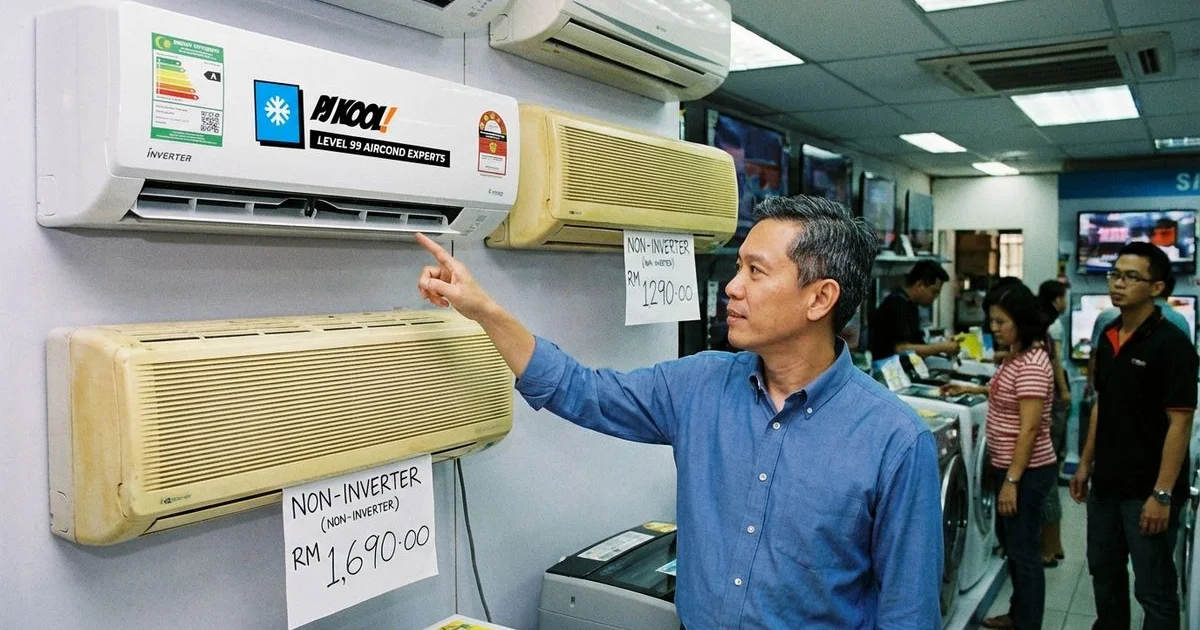
If you are shopping for a new aircond in Malaysia, the choice between inverter and non-inverter technology is likely your biggest hurdle. Inverter models command a higher upfront price.
Sellers will promise you that they “save electricity” to justify the cost.
We hear the same question from almost every customer in Petaling Jaya and Kuala Lumpur. Is the extra RM300 to RM800 really worth it?
Let’s look at the hard data so you can decide what works for your home.
How Non-Inverter Aircond Works
A non-inverter unit, often called a “fixed-speed” model, operates on a very simple principle. Its compressor has only two settings: 100% capacity or 0% capacity.
- You set the remote to 24°C.
- The compressor roars to life at full speed until the room sensor reads 24°C.
- The system cuts power to the compressor entirely.
- The room naturally warms up as heat enters from windows and walls.
- Once the temperature rises (usually by 2°C or 3°C), the compressor kicks back on at full blast.
- This cycle repeats indefinitely.
This operation is identical to driving your car in heavy KL traffic. You accelerate hard, then slam on the brakes, then accelerate again.
It consumes a significant amount of fuel. The constant stopping and starting also puts heavy mechanical stress on the internal components.
How Inverter Aircond Works
An inverter aircond uses a variable-speed compressor controlled by a precise logic board. This technology adjusts the power output to match the exact cooling load required.
- You set the temperature to 24°C.
- The compressor starts high to cool the room rapidly.
- As the room approaches 24°C, the motor does not stop.
- Instead, it slows down to a “cruising speed” to maintain the temperature.
- The room climate stays perfectly consistent.
We often compare this to driving on a clear highway with cruise control. You maintain a steady speed, your fuel consumption drops, and the engine runs quietly.
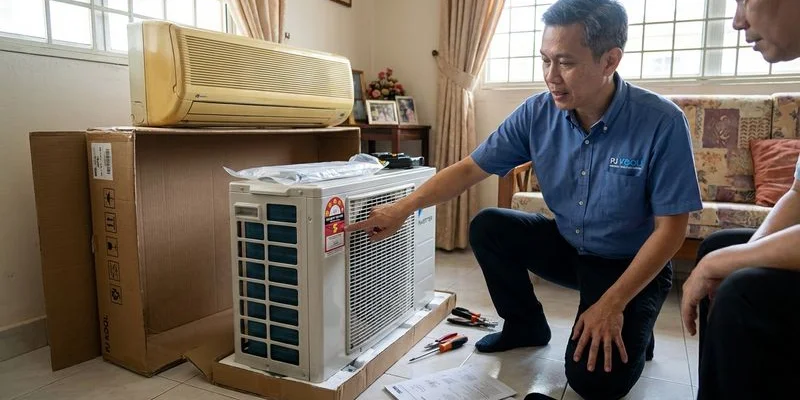
Head-to-Head Comparison
We have compiled the performance data for standard 1.5 HP wall-mounted units found in the Malaysian market.
| Feature | Non-Inverter (Fixed Speed) | Inverter (Variable Speed) |
|---|---|---|
| Price (1.5 HP) | RM900 - RM1,600 | RM1,600 - RM3,200 |
| Energy Efficiency | 3-star (Standard) | 4-5 star (High Efficiency) |
| Monthly Bill Impact | High (Frequent power spikes) | Low (Steady consumption) |
| Cooling Speed | Fixed (Wait for full cycle) | Fast (Powerful start-up mode) |
| Temperature Variance | Noticeable (±2°C swings) | Precise (±0.5°C stability) |
| Noise Level | Louder (Compressor click on/off) | Quiet (Consistent hum) |
| Lifespan | 8-12 years | 10-15 years |
| Repair Complexity | Low (Mechanical parts) | High (Electronic PCBs) |
| Repair Cost | Lower (Capacitor RM150+) | Higher (Mainboard RM400+) |
Energy Savings: The Real Numbers
The primary argument for buying an inverter is the reduction in your monthly Tenaga Nasional Berhad (TNB) bill.
We need to look at how Malaysia’s progressive tariff structure impacts these savings. The more electricity you use, the higher your rate per kilowatt-hour (kWh) becomes.
Typical Monthly Electricity Cost (1.5 HP, 8 hours/day)
The following estimates rely on typical usage in a terrace house in the Klang Valley.
| Usage Pattern | Non-Inverter Cost | Inverter Cost | Monthly Savings |
|---|---|---|---|
| Master Bedroom (8 hrs/night) | RM90 - RM120 | RM50 - RM70 | RM40 - RM50 |
| Living Hall (6 hrs/day) | RM70 - RM100 | RM35 - RM55 | RM35 - RM45 |
| Home Office (10 hrs/day) | RM120 - RM160 | RM65 - RM95 | RM55 - RM65 |
Note: These figures assume a tariff rate averaging 0.571 RM/kWh, which applies to consumption over 900kWh.
Break-Even Analysis
An inverter unit typically costs about RM600 more than a non-inverter equivalent.
If you save an average of RM50 per month on electricity:
- Break-even point: 12 months.
- Pure Profit: Years 2 through 10.
- Total 10-Year Savings: Approximately RM5,400 per unit.
For a household running three air conditioners, the cumulative savings often exceed RM15,000 over the lifespan of the equipment.
Which Is Better for Malaysian Conditions?
Our local climate is hot and humid year-round. This specific environment makes the choice clearer than in other countries.
Why Inverter Is Better in Malaysia
- High Usage Hours: Most Malaysians run their bedroom units for 8 to 10 hours every single night. Inverter technology is most efficient during these long, steady cooling periods.
- Humidity Management: An inverter runs continuously at a low speed. This allows the coil to stay cold and remove moisture from the air constantly. Non-inverters stop cooling entirely when the compressor cuts off, allowing humidity to rise immediately.
- TNB Tariff Protection: Heavy usage pushes you into the highest TNB tariff bracket (Block 5). Reducing your consumption helps keep your total bill in a lower, cheaper tier.
- Voltage Stability: Modern inverter units often have built-in protection against voltage fluctuation. This is helpful in older neighbourhoods in PJ where power delivery can be inconsistent.
When Non-Inverter Still Makes Sense
- The “Guest Room” Scenario: If a room is used less than 3 hours a day or only on weekends, you will never recover the extra upfront cost of an inverter through energy savings.
- Rental Properties: Landlords often prefer non-inverters. They are cheaper to buy and harder for tenants to damage through neglect.
- Voltage Spikes: While inverters handle small fluctuations well, they are sensitive to lightning strikes. If your area is prone to frequent lightning damage, the simpler electronics of a non-inverter are less risky.
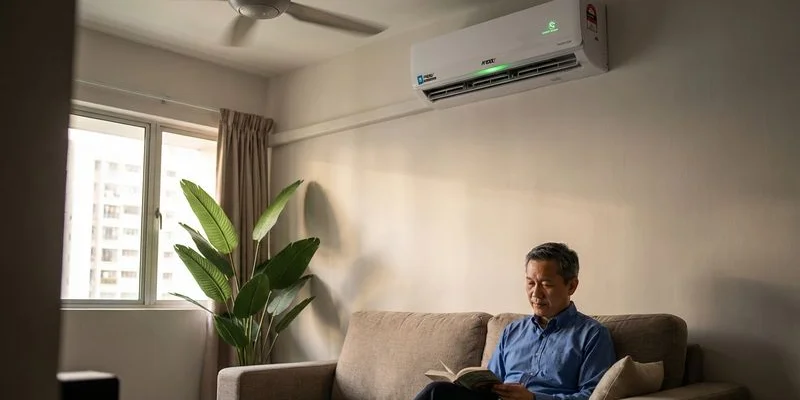
Maintenance Differences
We see a distinct difference in how these two types of units age over time.
Non-Inverter Maintenance
- Routine: Standard filter cleaning every 2-3 months.
- Deep Clean: Chemical service every 6-12 months.
- Repairs: Parts like capacitors and contactors are universal and cheap.
- Technician: Any general technician can fix these easily.
Inverter Maintenance
- Routine: Requires the same cleaning schedule as non-inverters.
- The “Pest” Risk: Inverter outdoor units contain sensitive Printed Circuit Boards (PCBs). Ants and lizards are attracted to the heat of these boards and can short-circuit them.
- Complexity: Troubleshooting requires specific diagnostic tools.
- Cost: If the main PCB fails out of warranty, replacement costs can range from RM400 to RM900 depending on the brand.
At PJ Kool, our team carries the specific diagnostic tools required for major inverter brands like Daikin, Panasonic, and York.
Mr. Heng’s Recommendation
Mr. Heng has spent over 15 years installing units across Damansara, Subang Jaya, and KL.
Here is his professional verdict for homeowners:
For Master Bedrooms and Living Rooms: Buy an Inverter. The silence alone is worth the money. You will sleep better without the “clunk” of the compressor starting up, and the temperature will not swing from freezing to warm. The electricity savings are a guaranteed bonus.
For Guest Rooms and Kitchens: Buy a Non-Inverter. These areas do not need precise temperature control. You save money upfront on a machine that will rarely run long enough to benefit from inverter efficiency.
The Golden Rule of Installation: If you buy an inverter, you must ensure the installer performs “vacuuming” during installation. This removes air and moisture from the pipes. Inverters using R32 or R410A gas are intolerant of moisture and will fail prematurely if this step is skipped.
Need Help Choosing or Installing?
Proper sizing is just as important as the technology you choose. An undersized inverter will run at 100% capacity constantly, defeating the purpose of buying it.
We can help you calculate the exact BTU requirements for your room size.
WhatsApp us directly at 012-2252 623 for a consultation on the best brands and models for your specific layout.
You can also visit our aircond installation page to verify our warranty terms and installation standards.
Tags:
inverter aircondnon-inverteraircond buying guideenergy savingMalaysia aircondelectricity bill
Related Articles!
Need Professional Aircond Help?!
Don't guess — let our senior technicians diagnose and fix your aircond. WhatsApp us now!